

Guide to official team merchandise: What UK fans need
TL;DR:
- The global licensed sports merchandise market is projected to reach $54.6 billion by 2035, with league licensing ensuring product authenticity and quality. Buying official gear involves strict approval processes, licensing layers, and guarantees, supporting teams, players, and community initiatives. Counterfeit merchandise lacks these safeguards, often offering inferior quality and contributing nothing to the sport’s ecosystem.
The global licensed sports merchandise market is on course to reach $54.6 billion by 2035, and the NFL alone generates roughly $3 billion in merchandise revenue every year. Yet for UK fans of American sports, the marketplace can feel like a minefield. Is that Kansas City Chiefs hoodie on a marketplace site the real thing, or a clever copy? Does “officially inspired” mean anything at all? This guide cuts through the noise, explaining exactly what official team merchandise means across the NFL, NBA, NHL, and MLB, and why it matters when you’re spending your money.
Table of Contents
- The basics: What makes merchandise ‘official’?
- How licensing works: The process behind the products
- Spotting the difference: Official vs counterfeit gear
- Edge cases and fan creativity: The limits of ‘official’
- Why buying official merchandise matters more than you think
- Where to find authentic US team merchandise in the UK
- Frequently asked questions
Key Takeaways
| Point | Details |
|---|---|
| Licensing defines official | Official team merchandise is produced by companies with league, team, and player association licences. |
| Spotting fakes | Check for holograms, tags, and retailer reputation to avoid counterfeit gear. |
| Support the sport | Buying official gear funds teams and players, while counterfeits undermine the industry. |
| Quality assurance | Licensed merchandise offers better materials, fit, and safety for UK fans. |
| Consider edge cases | Unlicensed fan creations can be creative but don’t support official leagues or athletes. |
The basics: What makes merchandise ‘official’?
The word “official” gets thrown around freely, but it has a precise meaning in the world of American sports apparel. Official team merchandise is apparel, gear, and products produced by companies that have obtained formal licences from the leagues themselves (such as NFL Properties), the individual teams, and the relevant players’ associations. Without all three layers of licensing in place, a product simply cannot be described as fully official.
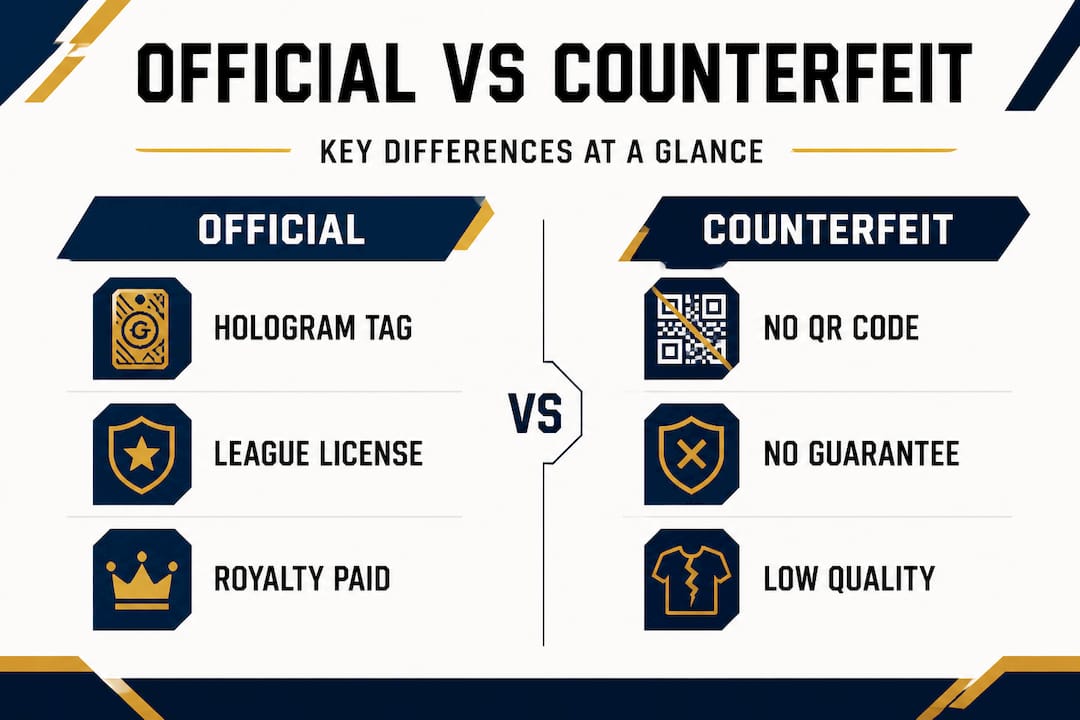
This matters because each layer covers something different. The league licence covers the shield, wordmarks, and general brand assets. The team licence covers specific logos, colours, and trade dress. The players’ association licence covers individual player names, numbers, and likenesses. When you see a Patrick Mahomes jersey in a reputable shop, it carries all three layers. When you see a “No. 15 red hoodie” on a dodgy website, you should ask which layers are missing.
Who licences what?
| League | Governing body | Players’ association |
|---|---|---|
| NFL | NFL Properties LLC | NFLPA |
| NBA | NBA Properties Inc | NBPA |
| NHL | NHL Enterprises LP | NHLPA |
| MLB | MLB Properties Inc | MLBPA |
The global merchandise market for licensed sports products is expanding rapidly, and UK fans represent a growing slice of that demand. Sales of NFL, NBA, and NHL gear in Britain have grown steadily alongside broadcast deals, social media, and the NFL’s London Games series. But that growing appetite also attracts counterfeiters and grey-market sellers.
Key things that distinguish official merchandise at a glance:
- Hang tags with the official league hologram or QR code
- Sewn or printed league marks inside the collar or hem
- Licensed manufacturer branding (such as Nike, Fanatics, or Mitchell & Ness)
- Consistent, accurate colour matching to the team’s official palette
- Player details that exactly match official rosters
If you want a deeper overview of what to look for, our authentic gear guide walks through every element in detail.
How licensing works: The process behind the products
Understanding what official means leads naturally to the next question: how does a product earn that status in the first place? The process is far more rigorous than most fans realise, and it is precisely that rigour that guarantees the quality you feel the moment you pull a genuine jersey over your head.
Here is how the licensing pipeline typically works:
- Application — A manufacturer applies to the relevant league properties body and submits brand credentials, manufacturing standards, and financial history.
- Design approval — Every colourway, logo placement, and font must be approved against the league’s brand standards manual, which runs to hundreds of pages for the NFL alone.
- Sample review — Physical samples are submitted and inspected before mass production is approved.
- Factory audits — The league or its appointed agents conduct audits of manufacturing facilities to check labour and safety standards.
- Royalty agreements — Licensees pay royalties of 10 to 12% of sales back to the league, which then distributes portions to teams and, where applicable, players’ associations.
- Ongoing compliance — Licences are renewed annually and can be revoked if standards slip.
This is why large, trusted companies like Fanatics, Nike, and Mitchell & Ness dominate official merchandise. The business of NFL merchandise at this level involves tens of millions of pounds in licensing infrastructure, not just screen-printing machines. Smaller operations simply cannot meet those standards.
“Every stitch on an official jersey is backed by months of design approvals, factory inspections, and legal agreements. Fans might not see the process, but they feel the difference when they wear it.”
Pro Tip: When you buy official merchandise, a portion of the price flows back to your team via royalties. For UK fans buying authentic NFL gear, that means your purchase is a small, real contribution to the game you love.
The same framework applies to basketball and ice hockey. NBA licensed apparel follows an almost identical model through NBA Properties Inc, ensuring that a Ja Morant Memphis Grizzlies jersey sold in Manchester carries exactly the same quality guarantees as one sold in Memphis itself.
Spotting the difference: Official vs counterfeit gear
With the licensing process in mind, it becomes much easier to understand why counterfeits look and feel wrong, even when they initially appear convincing. The NFL seizes approximately $40 million worth of counterfeit and unlicensed merchandise every single year, with enforcement ramping up significantly around major events like the Super Bowl. That figure tells you both how profitable the counterfeit trade is and how seriously leagues take the problem.
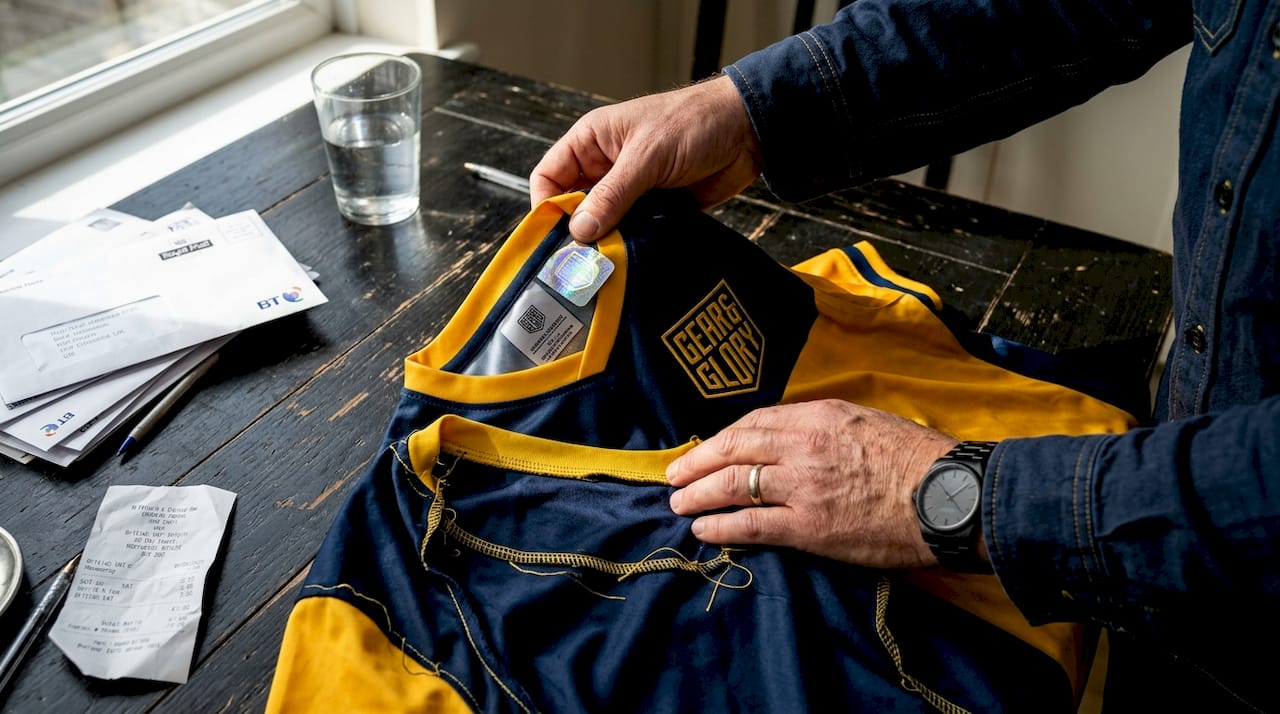
Official vs counterfeit: At a glance
| Feature | Official merchandise | Counterfeit/unlicensed |
|---|---|---|
| Tags and holograms | Present, scannable QR code | Missing or poorly replicated |
| Stitching | Clean, tight, consistent | Loose, uneven, or printed |
| Colours | Exact Pantone match | Slightly off, fades quickly |
| Fabric | Durable, moisture-wicking | Thin, rough, or pilling |
| Price | Reflects quality and royalties | Unusually cheap |
| Manufacturer branding | Licensed partner (Nike, Fanatics etc.) | Unknown or misspelled brand |
The physical differences are real and consistent. Official NFL and NBA jerseys use specific performance fabrics that meet league specifications. A counterfeit version will use cheaper substitutes that feel different, fade faster, and sometimes contain chemical dyes that haven’t passed safety testing. For anyone buying kit for a child, that last point is particularly worth noting.
Common warning signs to watch for:
- Misspelled player names or team names (sometimes only one letter off)
- Logos that are slightly the wrong shape or use the wrong number of colours
- No inner collar tag or a tag that looks photocopied rather than professionally printed
- “Official” written directly on packaging by the seller rather than on a proper hang tag
- Prices that are 60% or more below retail for what is claimed to be an authentic piece
Pro Tip: Most official NFL, NBA, NHL, and MLB products now include QR codes on their tags. Scanning that code should take you directly to the official licensee’s verification page. If it doesn’t work, or redirects you somewhere unexpected, treat the item with serious suspicion.
Knowing how to identify authentic sports apparel before you buy can save you both money and disappointment. And if you’re deciding between different types of genuine products, our comparison of replica vs authentic jerseys explains exactly what each tier offers.
Edge cases and fan creativity: The limits of ‘official’
Once you understand the licensing framework, you start to notice that the market isn’t simply divided into “official” and “fake.” There is a wide middle ground that includes genuinely interesting and even valuable pieces, but which occupies a more complex position.
A key nuance is that a product can hold a league licence but lack a players’ association licence. Some items carry team and league approval but cannot legally include any specific player name or number because the manufacturer hasn’t obtained separate rights from the NFLPA, NBPA, or equivalent body. These products are “official” in a limited sense: the logo is authorised, but the player reference is not.
Then there is the world of fan-inspired and creative merchandise. This includes:
- Airbrushed jerseys personalised at markets or fairs, often using officially licensed blank bases
- Vintage and throwback items produced before modern licensing frameworks existed
- Fan-designed prints celebrating a team or player aesthetic without directly copying trademarked elements
- Custom bootleg culture pieces that sit in a creative grey area, particularly in streetwear
None of these categories automatically makes a product poor quality or dishonest, but they do mean it sits outside the official licensing chain. When you buy them, you are not contributing to team royalties, and there is no quality guarantee beyond the seller’s own standards.
The question of whether to buy unlicensed gear is a personal one. Creativity and fan culture have always pushed at the edges of official frameworks, and some of the most visually striking pieces in any collector’s wardrobe are technically unlicensed. That said, if your priority is supporting your team directly, ensuring durability, or representing your favourite player accurately, then buying authentic jerseys remains the clearest path.
For NHL fans in particular, the nuances of merchandise authenticity are worth understanding in more depth. Official NHL merchandise carries some of the most detailed and carefully enforced standards in professional sport, partly because the league has worked hard to grow its international fanbase and wants every touchpoint to reflect quality. The NFL licensing background provides useful context on how this level of brand control developed over decades.
Why buying official merchandise matters more than you think
Here is where most guides stop: they tell you how to spot fakes and leave it there. But there’s a more important conversation to have, one that we at Gear & Glory think gets missed entirely.
The conventional wisdom is that official merchandise is about the logo looking right. That misses the point. When a UK fan buys a properly licensed Chicago Bulls snapback or a Green Bay Packers hoodie, they’re plugging into a financial ecosystem that funds player development, community outreach programmes, and the infrastructure that keeps these sports running at the level we love.
The royalty chain isn’t just a commercial formality. A portion of what you spend flows to the NFLPA or NBPA, which funds player welfare programmes, pension provisions, and youth development initiatives. The teams themselves receive revenue that helps smaller market franchises stay competitive. When you buy counterfeit gear to save £20, that £20 disappears entirely from the sport.
We’ve also noticed something interesting among UK fans specifically: many people who care deeply about authenticity in music, art, or craft don’t apply the same thinking to sports merchandise. They’d never buy a bootleg record or a fake trainers, but they’ll accept a £15 “inspired by” jersey without a second thought. The inconsistency is understandable, because the market is confusing. But once you understand what’s behind the official tag, the reasoning changes.
That said, we’re not going to pretend that official merchandise is the only merchandise worth owning. Vintage pieces, creative fan designs, and rare unlicensed throwbacks all have a place in a well-curated wardrobe. The key is knowing what you’re buying and why. Explore our authentic NHL apparel options if you want to see what properly licensed gear looks and feels like at the top end of the market.
The bottom line from our perspective: your purchase is a vote. Official merchandise is a vote for the sport, the teams, and the players. Make it with your eyes open.
Where to find authentic US team merchandise in the UK
Finding properly licensed American sports merchandise in the UK used to mean paying extortionate import fees or gambling on overseas websites. That has changed significantly, and UK fans now have genuinely good options for building a legitimate collection.
At Gear & Glory, we stock a carefully curated range of official and authenticated American sports apparel, sourced and verified so you don’t have to worry about what you’re getting. From authentic US sports caps covering every major NFL and NBA franchise to a growing range of vintage sports clothing that celebrates the golden eras of the game, every piece in our range is chosen for quality and authenticity. If you’re after something with genuine character, pieces like our vintage Adidas collegiate hoodie represent exactly the kind of standout apparel that bridges American sports culture and British streetwear sensibility. Browse the full range at Gear & Glory and find gear that means something.
Frequently asked questions
How can I tell if team merchandise is official?
Look for official hologram tags or QR codes, check for licensed manufacturer branding inside the garment, and verify via licensee directories or the league’s own website. Buying from a trusted, established retailer is the most reliable shortcut.
Why is official merchandise often more expensive?
The higher price reflects royalty payments of 10 to 12%, plus the cost of quality materials, design approvals, and factory audits that every official product must pass before it reaches shelves.
What are the risks of buying counterfeit sports merchandise?
Counterfeit gear lacks proper quality controls, may contain unsafe chemical dyes, and contributes nothing to your favourite team or players. It also tends to fade, tear, and deteriorate far faster than official alternatives.
Can I buy vintage or custom fan gear that isn’t officially licensed?
Yes, and some of it is genuinely interesting to own, but unlicensed custom gear does not carry quality guarantees or contribute royalties to the teams and players you’re celebrating. Know what you’re buying before you commit.
Recommended
- How to choose authentic NFL team apparel: UK fan guide – Gear&Glory UK
- Choosing the right NHL fan gear: a 2026 UK guide – Gear&Glory UK
- NBA merchandise terminology: a UK fan’s guide to authentic gear – Gear&Glory UK
- What is MLB merchandise? Your guide to authentic gear in the UK – Gear&Glory UK
- How to spot fake watches: expert guide for UK collectors