

Retro Nike apparel: spot the real deal and collect smart
TL;DR:
- Authentic retro Nike apparel is distinguished by specific tags, construction details, and age-related features, unlike modern reproductions. Collectors value genuine pieces for their historical significance, rarity, and cultural connection to American sports history. Building a collection requires patience, careful verification, and an understanding of era-specific details to ensure authenticity and long-term value.
Not all old-looking Nike gear is the real thing. That much surprises plenty of new collectors, who assume a faded swoosh and a worn-out collar make something genuinely retro. The market for authentic retro Nike apparel has grown sharply among UK fans of American sports and streetwear, and with that demand has come a wave of reproduction pieces designed to look the part without the history to back it up. Tag designs vary by period and serve as one of the most reliable tools for separating the genuine article from a convincing imitation. This guide gives you the clarity and practical skills to shop with confidence.
Table of Contents
- Defining retro Nike apparel: beyond just old clothes
- Spotting authentic retro Nike: tags, details and dating clues
- Why collectors covet retro Nike: rarity, style and culture
- Building your own retro Nike collection: tips for UK fans
- Why the real thrill of retro Nike is about story, not just style
- Find authentic retro Nike and US sports style in the UK
- Frequently asked questions
Key Takeaways
| Point | Details |
|---|---|
| Not all ‘old’ Nike is retro | Retro Nike refers to items designed in tribute to earlier eras, not just any second-hand or aged piece. |
| Tag details matter | Learn to read and date Nike labels for the best chance of authenticating your finds. |
| Multiple clues ensure authenticity | Always check tags, material quality, construction and graphics to avoid reproductions. |
| Collector community adds value | UK enthusiasts share advice and authenticity checks, making the hunt more fun and secure. |
| Gear&Glory offers curated picks | Find trusted, authentic retro Nike and American sportswear at specialist UK retailers like Gear&Glory. |
Defining retro Nike apparel: beyond just old clothes
With the confusion set, let’s start by pinning down what ‘retro’ means compared to ‘vintage’ or ‘reissue’ for Nike fans.
These three words get thrown around constantly, but they describe very different things. Confusing them costs collectors money and leads to genuine disappointment when a prized purchase turns out to be a modern knockoff dressed up to look historic.
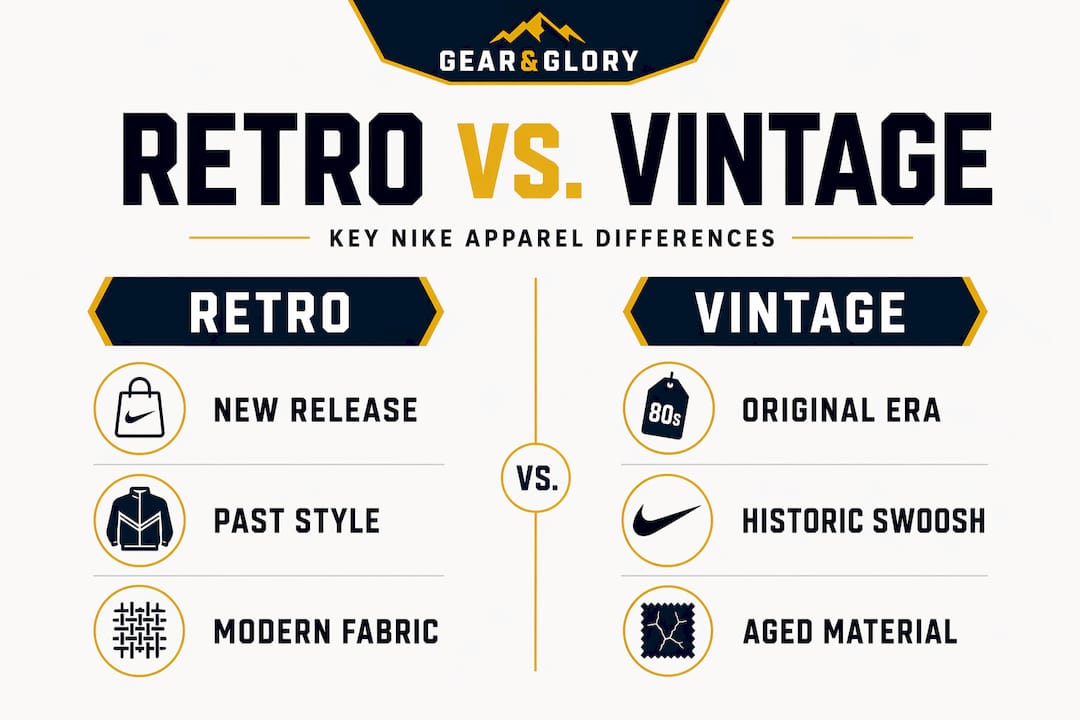
Retro describes a style or silhouette from a past era that has been reintroduced or reissued in later years. Nike themselves have done this deliberately, bringing back popular colourways and cuts decades after the originals. Vintage refers specifically to garments actually produced during a particular historical period, typically at least 20 years ago. Reissue sits somewhere between the two: it is a deliberate recreation of an older design, produced intentionally by the brand, often with updated materials.
In US collector culture, the lines between retro and vintage can blur further, with some communities using ‘retro’ to mean anything over ten years old. UK collectors, influenced by both American and European fashion traditions, often apply stricter definitions. Our vintage apparel buying guide covers this territory in more depth if you want to sharpen your terminology before you start hunting.
The appetite for American sporting nostalgia is very real across the UK. Fans who grew up watching NBA highlights or NFL games through the 1980s and 1990s associate Nike gear with moments of genuine cultural significance. That emotional pull drives demand, and demand drives both prices and the flood of reproduction pieces.
Here is a quick comparison to make the distinctions concrete:
| Term | Origin period | Produced by | Typical age |
|---|---|---|---|
| Vintage | Past era | Original manufacturer | 20+ years |
| Retro | Past-inspired | Brand (modern production) | New but old-styled |
| Reissue | Past design | Brand (deliberate remake) | New, clearly labelled |
| Reproduction | Past era inspired | Third party | New, often misleading |
Key things to know when starting out:
- Genuine vintage Nike pieces carry tags specific to their decade of production
- Retro reissues from Nike are legitimate products, but they are not vintage
- As tag types change by decade, the 70s pinwheel logo, 80s blue labels, 90s grey and red tags, and 2000s silver tags each tell a distinct story
- UK charity shops and car boot sales occasionally surface genuine vintage finds, but they require careful verification
Spotting authentic retro Nike: tags, details and dating clues
Once you know what makes a piece ‘retro’, it is crucial to understand exactly how collectors differentiate the genuine article from ‘vintage-style’ fakes.

The single most important tool in your arsenal is the tag. Nike’s internal labels changed significantly across each decade, and learning these changes is the foundation of any serious collector’s knowledge. Collectors rely on Nike tag details as era clues because the variations are specific enough to date a piece reliably.
Here is a decade-by-decade breakdown of key tag characteristics:
| Era | Tag colour | Logo style | Key indicators |
|---|---|---|---|
| 1970s | Orange/white | Pinwheel or early swoosh | Very simple typography, made in USA |
| 1980s | Blue/white | Bold swoosh | “Made in Korea” appears; bold font |
| 1990s | Grey and red | Modern swoosh | Multi-language text begins |
| 2000s | Silver/grey | Simplified modern | Barcode and care icons standard |
Many fakes use convincingly aged tags, which is why experienced collectors never rely on the tag alone. The construction of the garment tells its own story. Look at the stitching density, the quality of the seam finishes, and how the logo is applied. Genuine 1980s and 1990s Nike pieces often used embroidered logos rather than printed ones, and the thread colours used reflect the limited palettes of the period.
Here is a practical verification checklist when examining a piece:
- Examine the tag under good light, checking font weight, colour, and any signs of artificial ageing
- Study the stitching along seams and around any logo applications
- Check the fabric composition label for period-accurate materials (nylon, polyester blends specific to the era)
- Look at the graphic or print for natural cracking and fading patterns rather than artificial distressing
- Research the specific colourway or model to cross-reference with known production records
- Compare the piece against authenticated examples from must-have vintage examples to sharpen your eye
Pro Tip: Pay particular attention to the care label. Many reproductions use modern care symbols that simply were not in use during the era they are imitating. A genuine 1980s Nike piece will not have the international care symbols that became standard in the 1990s.
The edge cases matter too. Some items genuinely sit between categories because they were produced at a transitional moment in Nike’s history or feature characteristics from two different eras. A garment with a 1990s tag but 1980s construction details might be an authentic transitional piece or it might be a clever fake. Weigh every factor together rather than relying on one detail.
Why collectors covet retro Nike: rarity, style and culture
Knowing how to spot authentic pieces is only half the story. Understanding why collectors and style enthusiasts chase these items completes the picture.
“The best pieces are not just clothes. They are evidence that a particular moment in American sports history happened, and you are holding a piece of it.”
Scarcity is the primary driver of collector value. Nike produced certain styles in limited numbers, tied to specific sports seasons or player endorsements. Once those original runs sold through, no legitimate supply remained. When demand from a new generation of collectors and streetwear enthusiasts combines with that limited supply, prices rise sharply.
Nike’s connection to American sports culture is also deeply personal for UK fans. The brand’s dominance across NBA, NFL, and athletics through the 1980s and 1990s means that pieces from those eras carry genuine emotional weight. Wearing a 1992 Nike warmup jacket or a mid-90s training top connects you to a specific chapter of sports history that many UK fans experienced through television and magazines.
Certain eras stand out as particularly desirable:
- Late 1980s: The rise of basketball culture and the Michael Jordan effect made Nike gear globally iconic
- Early 1990s: Bold colour blocking and large logo applications created a distinctive aesthetic
- Mid-1990s: The ‘outdoor explorer’ and ACG lines produced distinctive styles now highly sought after
- Late 1990s: Compression-fit designs and technical fabrics marked a design shift collectors value
Authentication should always consider multiple evidence points including tag, construction, fabric, and graphic or print ageing together. This is especially true for pieces that sit on the retro-vintage border, where a single detail might mislead you.
Pro Tip: Understanding which US sports teams Nike had official relationships with during specific eras helps authenticate team-linked pieces. Cross-reference kit designs with team records and photographic archives to confirm a garment’s legitimacy.
The cultural dimension of retro Nike collecting is explored in depth within our writing on vintage jersey culture, where the overlap between fashion, sport, and identity becomes very clear. Similarly, if your focus is on American football heritage, the case for vintage NFL gear value goes well beyond simple aesthetics.
Building your own retro Nike collection: tips for UK fans
If you are ready to hunt for your own pieces, here is how UK fans are making their retro Nike collections stand out.
Starting a collection does not require a huge budget, but it does require patience and education. The biggest mistake new collectors make is moving too quickly, buying on aesthetics alone and ignoring the verification process.
Here is how to build a collection you will be proud of:
- Set a focus area first. Decide whether you are collecting by era, by sport, by colourway, or by a specific Nike sub-line. A focused collection tells a clearer story and is easier to authenticate consistently.
- Source carefully. UK-based specialist retailers with authenticated stock are far safer than general resale platforms where provenance is unclear. Look for sellers who can provide detailed tag photographs before you buy.
- Check tags every single time. Even when dealing with a trusted seller, tag details remain essential for confirming what you are actually purchasing. Never skip this step.
- Document your pieces. Photograph tags, labels, and construction details when you acquire each item. This creates your own reference archive and supports the item’s value if you ever sell.
- Care for what you own. Store garments flat or on padded hangers in cool, dry conditions away from direct light. Wash only when necessary, using cold water and a gentle cycle, and never tumble dry vintage pieces.
- Connect with the community. UK collector forums and social media groups focused on vintage American sportswear offer authentication help, market intelligence, and a network of fellow enthusiasts who can identify pieces you are unsure about.
Pro Tip: When purchasing from markets or charity shops, carry a UV torch. Certain modern reproductions use optical brighteners in their fabrics that glow under UV light, revealing them as modern pieces regardless of how convincingly they have been aged.
Our full guide on building a UK vintage collection goes deeper on the practical side of sourcing, storing, and growing a collection that retains its value over time.
Why the real thrill of retro Nike is about story, not just style
Here is something the trend-focused coverage of retro Nike rarely addresses: the clothes themselves are secondary. What experienced collectors genuinely value is the detective work, the history, and the connection to a bigger cultural narrative.
When you spend an afternoon researching a mid-1980s Nike track jacket, cross-referencing the tag with production records, identifying the exact colourway from archive images, and confirming the construction details against authenticated examples, you are not just buying a garment. You are learning a chapter of American sports history and building a skill that most people do not possess. That knowledge has lasting value in ways that owning a convincing reproduction simply cannot replicate.
We also think the UK collector community is one of the best-kept secrets in retro sports apparel. The willingness of experienced collectors here to help newcomers separate genuine pieces from hyped-up fakes is remarkable. Unlike some markets where information is hoarded to maintain competitive advantage, the vintage Nike community tends toward openness. People share tag guides, call out obvious fakes in public forums, and mentor newer collectors with real generosity.
What concerns us about the current moment is the pace at which new collectors are moving. The visibility of retro Nike on social media has created a new wave of enthusiasm, which is genuinely exciting. But visibility also creates pressure to acquire quickly, and quick acquisition leads to mistakes. Buying a reproduction at a vintage price is demoralising and expensive.
Our honest recommendation: spend your first three months learning rather than buying. Study tags. Handle as many authenticated pieces as you can, at markets, in specialist shops, in collector meetups. When you do know what NBA collecting experience has taught seasoned enthusiasts, you will spend with confidence rather than hope.
Authenticity creates a kind of satisfaction that lookalike pieces genuinely cannot match. Every piece in your collection will mean something specific, tell a precise story, and connect you to a moment in American sports culture that actually happened. That is what makes the hunt worthwhile.
Find authentic retro Nike and US sports style in the UK
At Gear & Glory, we understand exactly what UK collectors and sports fans are looking for, because we are part of the same community. Our stock is curated with authenticity as the starting point, not an afterthought.

Whether you are starting your first collection or adding to an established one, our vintage Nike and streetwear collection brings together genuine pieces sourced with care. For fans of American sports culture from cap to toe, our selection of authentic US sports caps completes any outfit with the right provenance. If you are drawn to the broader world of branded American sportswear, our full range of Nike and Adidas streetwear covers both vintage finds and modern classics. Based in Market Deeping, we are here for fans who want the genuine article, every time.
Frequently asked questions
What’s the difference between retro and vintage Nike apparel?
Retro Nike refers to items inspired by past designs but made more recently, while vintage Nike means pieces actually produced in a previous era. As one identification guide confirms, vintage tags change by decade, which helps collectors distinguish the two.
How can you tell if a Nike item is genuinely vintage or a modern reproduction?
Check the tag style, logo, stitching quality, and fabric composition alongside natural signs of ageing. Genuine vintage pieces have era-specific tag designs that reproductions frequently get wrong in subtle but identifiable ways.
Are UK-produced Nike items ever considered retro or vintage?
Most highly collectible retro or vintage Nike apparel originates from US production runs, though certain UK-market pieces from the 1980s and 1990s do exist and are beginning to attract collector interest.
Why do collectors value certain Nike tags or eras more highly?
Specific tags and production eras signify limited runs, particular design movements, or historical connections to iconic athletes, and vintage Nike tags serve as key clues to which era and run a piece belongs to.
How do I care for retro Nike clothing to keep its value?
Store garments in cool, dry conditions away from direct sunlight, wash only when essential using cold water and gentle methods, and never use a tumble dryer, as heat degrades both fabric and tags significantly over time.